 Antonio Caggiano
27e4f24800
Antonio Caggiano
27e4f24800
- Vulkan implementations in `RenderingDeviceDriverVulkan`.
- Raytracing instruction list in `RenderingDeviceGraph`.
- Functions to create acceleration structures and raytracing pipelines
  in `RenderingDevice`.
- Raygen, Miss, and ClosestHit shader stages support.
- GDScript bindings.
- Update classes documentation.
- Unimplemented placeholders for Metal and D3D12.
- Build acceleration structure command.
- Expose a shader preprocessor define.
- Align build scratch address.
- Create STB after creating the pipeline.
- Separate acceleration structure barriers.
- Use transforms in TLAS instances.
- AnyHit and Intersection stages.
- Optionally set acceleration structure build input buffer usage.
- Introduce instances buffer.
- Move scratch buffers to RenderingDevice.
- Rename AccelerationStructureGeometryBits.
- Use regular buffer creation and free routines for scratch buffer.
- Store trackers in acceleration structures.
- Bump Shader SPIR-V version to 1.4
- Add Position attribute location in blas_create.
- Encapsulate MoltenVK check in preprocessor macro.
- Split SUPPORTS_RAYTRACING for pipeline and query.


Godot Engine

2D and 3D cross-platform game engine
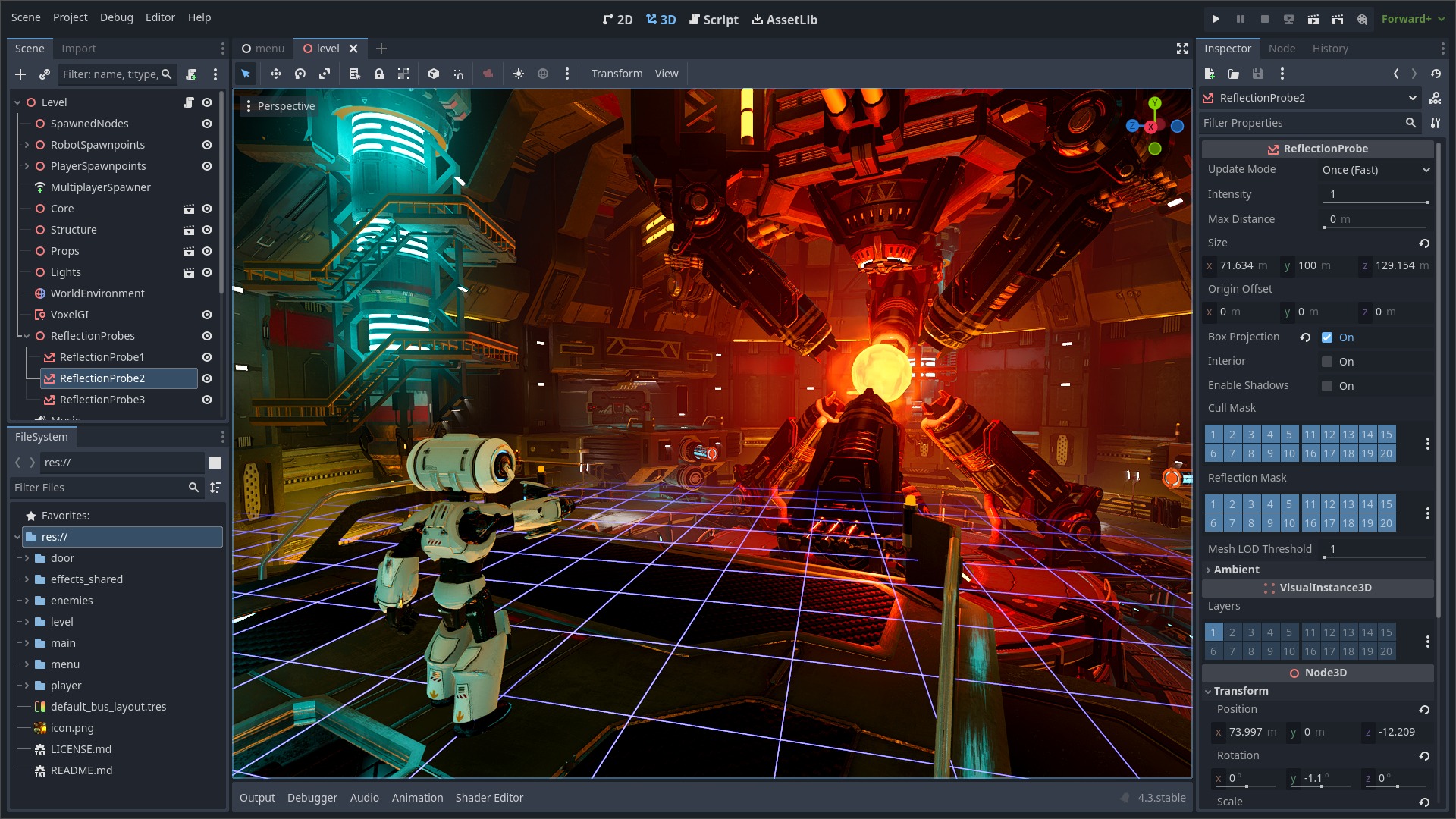
Godot Engine is a feature-packed, cross-platform game engine to create 2D and 3D games from a unified interface. It provides a comprehensive set of common tools, so that users can focus on making games without having to reinvent the wheel. Games can be exported with one click to a number of platforms, including the major desktop platforms (Linux, macOS, Windows), mobile platforms (Android, iOS), as well as Web-based platforms and consoles.
Free, open source and community-driven
Godot is completely free and open source under the very permissive MIT license. No strings attached, no royalties, nothing. The users' games are theirs, down to the last line of engine code. Godot's development is fully independent and community-driven, empowering users to help shape their engine to match their expectations. It is supported by the Godot Foundation not-for-profit.
Before being open sourced in February 2014, Godot had been developed by Juan Linietsky and Ariel Manzur (both still maintaining the project) for several years as an in-house engine, used to publish several work-for-hire titles.
Getting the engine
Binary downloads
Official binaries for the Godot editor and the export templates can be found on the Godot website.
Compiling from source
See the official docs for compilation instructions for every supported platform.
Community and contributing
Godot is not only an engine but an ever-growing community of users and engine developers. The main community channels are listed on the homepage.
The best way to get in touch with the core engine developers is to join the Godot Contributors Chat.
To get started contributing to the project, see the contributing guide. This document also includes guidelines for reporting bugs.
Documentation and demos
The official documentation is hosted on Read the Docs. It is maintained by the Godot community in its own GitHub repository.
The class reference is also accessible from the Godot editor.
We also maintain official demos in their own GitHub repository as well as a list of awesome Godot community resources.
There are also a number of other learning resources provided by the community, such as text and video tutorials, demos, etc. Consult the community channels for more information.

